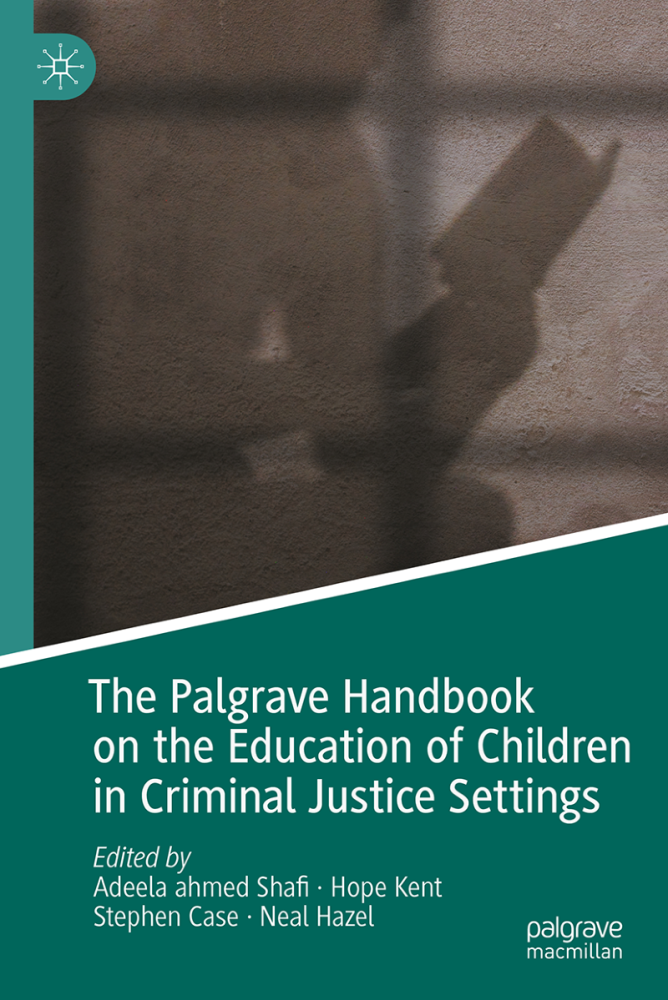
The Palgrave Handbook on the Education of Children in Criminal Justice Settings.
More information about the book can be accessed here.
TRYJustice members have been working on the first international handbook on the Education of Children in Criminal Justice Settings. As written in article 28 of the UN CRC (which every member state except the US ratifies - making it the most widely ratified human rights treaty) children have a right to education - regardless of who or where they are. However, for children in custody, provision is falling short. In England and Wales, some estimates indicate 1 in 5 children in custody receive no education offering, and those who are in Young Offender's Institutions receive about 15 hours per week (rather than the government target of 30 hours).
Children arrive in custodial settings usually having experienced significant disruption to their education already - through school exclusion. Education may not have felt meaningful or important to them as they are trying to navigate and survive difficult life circumstances. They have also often experienced family dysfunction, care-experience, poverty, trauma, abuse, parental incarceration, and may have been marginalised because of their race or gender. The majority have a special educational need or neurodevelopmental condition. Often, these complex needs haven't been recognised or catered for in their previous engagements with education. They may have been punished, rather than offered relational support. So - how do we deliver education for children with these complex and intersecting needs? How do we re-engage children on the margins of society with learning, and offer them social mobility, a new sense of identity, and routes towards a better life?
In the book we propose some new CHILD-friendly principles for the delivery of education in youth justice settings:
- C – Collaborative: Where the child is an active and capable collaborator in their own education, not a passive recipient. Approaches like authentic inquiry let children shape what and how they learn, which makes curricula meaningful to them.
- H – Holistic: Education responds to the "whole child," including neurodevelopmental conditions, SEND, and histories of psychological trauma and adversity. This requires a comprehensive assessment of needs.
- I – Inclusive: Education should take into account the social context of the child, recognising that children in the youth justice system have often been marginalised across societal structures prior to their criminalisation. They have frequently previously been excluded from school, and experienced marginalisation by race, ethnicity, or immigration status, and gender.
- L – Life-focused: It is important to widen the definition of "curriculum" beyond academic study for these children, to include and value skills for life learned through peer mentoring, restorative approaches, entrepreneurship and social-mobility skills, and building a pro-social identity.
- D – Developmental: Education must sit within a wider system that sees children as children first, recognising their developmental vulnerability rather than treating them as adults.
John Rawls suggested that 'Justice is Fairness' - these children are the most vulnerable and marginalised in our society. They have experienced incredible trauma and adversity, and been punished and excluded in mainstream schools. We therefore owe it to them to deliver an excellent education offer in custody - to act as reparation for the injustices they have experienced so far. But our current offers are falling far short of the mark.